

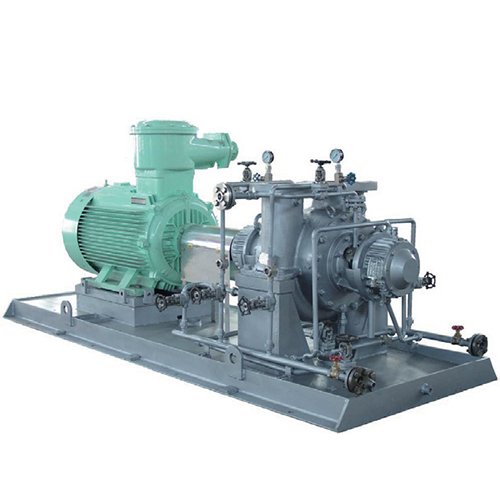
KDA series petrochemical process pump
In order to meet the needs of the modern construction of my country’s petrochemical equipment, to adapt to the upgrading of equipment centered on energy conservation as soon as possible, and to develop products that are in line with international advanced production according to API610 specifications, our factory has introduced the KDA type petrochemical process that is suitable for my country’s specific conditions. Pump.
KDA type process pump is used in petroleum refining, petrochemical and chemical industries and other places to transport petroleum and its products. It fully complies with the American Petroleum Institute API610 specifications.
KDA process pump has the characteristics of high reliability, long service life and high degree of generalization, especially the efficiency is more outstanding.
KDA series petrochemical process pump
Comply with API610th8/th9/th10/th11 design standards
Flow Q=95~1740m³/h
Lift H=38~280m
Working pressure (P): up to 5.0Mpa
Working temperature (t): -45℃~+450℃
This series of pumps is particularly suitable for transporting petroleum and its products in petroleum refining, petrochemical and chemical industries and other places. This series of pumps has the characteristics of high reliability, long service life, high degree of generalization and high efficiency.
- performance range
- Model Description
- Structural features
- pump steering
- structure diagram
Flow: Q=95~1740m³/h
Lift: H=38 ~ 280m
Operating temperature: t=- 45~ +450℃
KDA 200/250-455 H
KDA——pump series code
200——Exit diameter (mm)
250——Inlet diameter (mm)
455——Nominal diameter of impeller (mm)
H——impeller type code
KDA type pump is a single-stage double-suction centrifugal process pump supported at both ends, with a radially split pump casing. It is especially suitable for transporting high temperature and high pressure as well as flammable, explosive or toxic liquids. The installation method is a horizontal centerline support to minimize the deformation and displacement caused by thermal expansion and contraction. The pump body is designed as a double vortex chamber to balance the radial force of the pump.
The pump can exhaust itself by relying on the flow of pressurized liquid, but there are navels on the upper and lower parts of the volute of the pump body. When the user needs to exhaust and drain, the Rc3/4 screw hole can be opened and screwed on with a plug before leaving the factory. .
The suction and discharge flanges of the pump are vertically upward and are integrally cast with the pump body. The flange size and pressure rating are equivalent to the American Standards Institute (ANSI) standard rating. Depending on the operating temperature and material category,
The maximum operating pressure of the flange can reach about 5MPa.For reliability, KDA-type processes all use cast steel shells, and their hydrostatic pressure test is 7MPa.
The shaft seal cavity and the pump body are cast into one body. It can be equipped with packing seals and balanced, bellows or string type mechanical seals. An optional water-cooling cavity jacket is cast outside the cavity. The water-cooling jacket must be specially equipped. It is required or used when the temperature of the conveying medium is water exceeding 66°C and the temperature of hydrocarbons exceeding 150°C. When the conveyed medium needs to be insulated, low-pressure steam or other insulating media can also be introduced into the jacket.
The hydrostatic pressure test 1MPa cooling water inlet connector Rc1/2 is below the pump cover, and the outlet connector Rc1/2 is above the pump cover.The steam inlet connector Rc1/2 is above the pump cover, and the outlet connector Rc1/2 is below the pump cover.
The impeller is integrally cast and is dynamically balanced along with the rotor. It is driven by a key to the shaft, and the rotor is supported at both ends. The shell sealing ring or the impeller sealing ring are both replaceable standard parts. The good matching between the two is ensured by the difference in materials and hardness.
The seals at both ends of the impeller are intentionally designed to have different sizes, that is, the sealing ring on one side of the thrust bearing is slightly smaller than the other side, causing the pump to exert a slight axial force and make the shaft always work under tension.Avoid the left and right movement of the rotor.
Both ends of the pump are bearing bodies of the same size. The materials are cast steel and cast iron. They are fastened to the bracket with bolts and positioned with matching seams.A set of radial bearings is installed on the coupling end, and two sets of back-to-back thrust bearings are installed on the other end.The bearings are lubricated by an oil slinger ring with a moderate amount of oil. Each bearing has an axial heat sink cast outside the body.It is available for air cooling (t≤120℃), fan cooling (t=120℃-260℃), and water cooling (t≥260℃). Fan cooling is especially suitable for areas with water shortage or poor water quality.
When the pump bearing is cooled by a fan, the fan will replace the dust disk. This is also the unique feature of this type of pump. When the pump bearing is cooled by water, a water-cooling jacket is cast on the outside of the ball bearing.
The bearing body is equipped with a visible circular oil mark and an oil cup to monitor and control the oil level. The bearing body is equipped with copper dust-proof disks at both ends, extending to the inner hole of the bearing gland.It can prevent dust or water from entering and prevent oil leakage. When the bearing should break, it can also play a supporting role.
For inspection and maintenance, the impeller, bearings, shaft seals, etc. can be easily removed without disassembling the suction or discharge pipelines. The KDA process pump uses a flexible diaphragm to extend the coupling component, and it matches the pump shaft in a tapered shape, making it very easy to disassemble and assemble.
The rotation direction is counterclockwise when viewed from the prime mover toward the pump.

| 1 | Pump body | 5 | Bearing body parts | 9 | Impeller seal ring |
| 2 | pump cover | 6 | Packing seal parts | 10 | Housing sealing ring |
| 3 | impeller | 7 | support rack | 11 | throat bushing |
| 4 | shaft | 8 | Mechanical seal components |
Cooling water: In order for the pump to work normally, the shaft seal cavity, bearings and pump bracket must be cooled in different forms according to the working conditions. The cooling water pipeline layout should comply with Figure D-5 in Appendix D* of the API610 specification. , usually fully equipped on the pump, leaving only the inlet and outlet joints.
The minimum nominal diameter of the cooling water line is 1/2”.
Cooling water volume: Each branch pipeline is recommended to be 0.3-0.7 m³/h, and its pressure is 0.1-0.3MPa.
Sealing oil: Shaft seals use different seals based on the pump delivery medium and its working conditions such as temperature and pressure. The layout of the sealing pipeline system should comply with Figures D-2 and Figure D-3 in Appendix D* of the API610 specification. , if the user does not specifically request it, it will be assembled by the pump factory.
The flushing pressure and oil volume of sealing oil are considered by the pump factory itself. Data will only be provided when external supply is required. The sealing oil volume of each pump chamber is as follows:
| Seal nominal diameter (mm) | 13-47 | 48-59 | 60-84 | 85-95 | 96-133 |
| Average sealing oil volume (L/s) | 0.05 | 0.067 | 0.10 | 0.13 | 0.18 |
The pressure of the sealing chamber is generally 0.07-0.1MPa higher than the pressure of the sealing chamber. If the conveying medium is easily vaporized, it should be 0.175-0.2MPa higher than the vaporization pressure. The pressure P in the sealing chamber of this type of pump is generally equal to the inlet pressure Ps, that is, P=Ps.
The coolers, filters, orifice plates, flow indicators and other accessories required on the pipeline are all supplied by the pump factory.
When Appendix D of the API610 specification changes, the process pump also changes.
| Material grade/Material/Parts | S-I | S-4 | S-6 | C-6 | A-8 |
| Pressure-bearing shell (body, cover) | ZG230-450 | ZG230-450 | ZG230-450 | ZG1Cr13Ni | ZGCr18Ni12Mo2Ti |
| impeller | HT250 | ZG230-450 | ZG1Cr13Ni | ZG1Cr13Ni | ZGCr18Ni12Mo2Ti |
| Housing sealing ring | HT250 | HT250 | ZG1Cr13MoS | ZG1Cr13MoS | 0Cr18Ni12Mo2Ti |
| Impeller seal ring | QT500-7 | QT500-7 | 3Cr13 | 3Cr13 | 0Cr18Ni12Mo2Ti |
| shaft | 45 | 45 | 42CrMo or 35CrMo | 3Cr13 | Cr18Ni12Mo2Tj |
| packing bushing | 3Cr13 | 1Cr13 Stacked tungsten carbide |
1Cr13 Stacked tungsten carbide |
1Cr13 Stacked tungsten carbide |
Cr18Ni12Mo2Ti |
| Mechanical seal sleeve | 1Cr18Ni9 or 3Cr13 | 1Cr18Ni9 or 3Cr13 | Cr18Ni9 or 3Cr13 | 1Cr18Ni9或 3Cr13 |
Cr18Ni12Mo2Ti |
The materials of the main parts of the pump are shown in the table above. In addition to the above five materials, users can also choose the other six materials specified in the API610 specification, but they need to negotiate with the manufacturer.